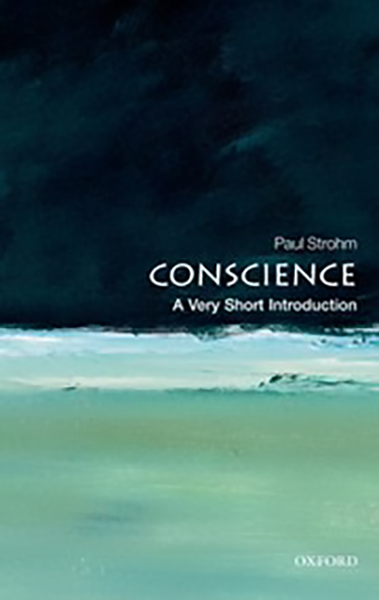
Conscience - A Very Short Introduction
ISBN: 9780199569694
Size: 111 * 174
Weight: 128 g
Page no.: 152
Publish year: 2011
Conscience - A Very Short Introduction
Where does our conscience come from? How reliable is it?
In the West conscience has been relied upon for two thousand years as a judgement that distinguishes right from wrong. It has effortlessly moved through every period division and timeline between the ancient, medieval, and modern. The Romans identified it, the early Christians appropriated it, and Reformation Protestants and loyal Catholics relied upon its advice and admonition. Today it is embraced with equal conviction by non-religious and religious alike.
Considering its deep historical roots and exploring what it has meant to successive generations, Paul Strohm highlights why this particularly European concept deserves its reputation as `one of the prouder Western contributions to human rights and human dignity throughout the world.`
Using examples from popular culture including the Disney classic Pinocchio, as well as examples from contemporary politics, he explores the work of thinkers such as Nietzsche, Freud, and Aquinas, to show how and why conscience remains a motivating and important principle in the contemporary world.
Table of Contents:
1: Encountering conscience
2: Christian conscience
3: The secularization of conscience
4: Three critics of conscience: Dostoevsky, Nietzsche, Freud
5: Is conscience a civil right?
6: The prospects for conscience
Author Information:
Paul Strohm is the Anna Garbedian Professor of the Humanities at Columbia University. He was formerly J.R.R. Tolkien Professor of Language and Literature at the University of Oxford, where he continues as Research Fellow of St Anne`s College. He has written five books including: Social Chaucer (Harvard, 1989, 1994); Hochon`s Arrow: The Social Imagination of Fourteenth-Century Texts (Princeton, 1992); Theory and the Premodern Text (Minnesota, 2000); and Politique: Languages of Statecraft Between Chaucer and Shakespeare (Notre Dame, 2005).
Series: Very Short Introductions
Category: Filozófia, Filozófia / etika, Vallás