
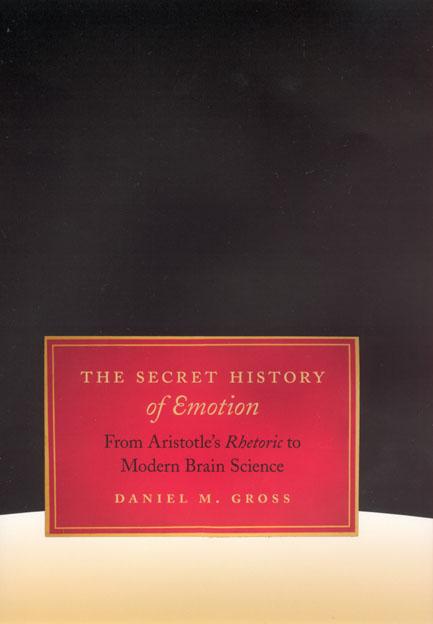
The Secret History of Emotion - From Aristotle`s Rhetoric to Modern Brain Science
ISBN: 9780226309804
Size: 141 * 216
Weight: 252 g
Page no.: 200
Publish year: 2007
The Secret History of Emotion - From Aristotle`s Rhetoric to Modern Brain Science
Princess Diana’s death was a tragedy that provoked mourning across the globe; the death of a homeless person, more often than not, is met with apathy. How can we account for this uneven distribution of emotion? Can it simply be explained by the prevailing scientific understanding? Uncovering a rich tradition beginning with Aristotle, The Secret History of Emotion offers a counterpoint to the way we generally understand emotions today.
Through a radical rereading of Aristotle, Seneca, Thomas Hobbes, Sarah Fielding, and Judith Butler, among others, Daniel M. Gross reveals a persistent intellectual current that considers emotions as psychosocial phenomena. In Gross’s historical analysis of emotion, Aristotle and Hobbes’s rhetoric show that our passions do not stem from some inherent, universal nature of men and women, but rather are conditioned by power relations and social hierarchies. He follows up with consideration of how political passions are distributed to some people but not to others using the Roman Stoics as a guide. Hume and contemporary theorists like Judith Butler, meanwhile, explain to us how psyches are shaped by power. To supplement his argument, Gross also provides a history and critique of the dominant modern view of emotions, expressed in Darwinism and neurobiology, in which they are considered organic, personal feelings independent of social circumstances.
The result is a convincing work that rescues the study of the passions from science and returns it to the humanities and the art of rhetoric.
CONTENTS:
Acknowledgments
Introduction: A New Rhetoric of Passions
1. Early Modern Emotion and the Economy of Scarcity
2. Apathy in the Shadow Economy of Emotion
3. Virtues of Passivity in the English Civil War
4. The Politics of Pride in David Hume and David Simple
5. Thinking and Feeling without a Brain: William Perfect and Adam Smith’s Compassion
Index
AUTHOR:
Daniel M. Gross is professor of English and director of composition at the University of California, Irvine. He is the author of The Secret History of Emotion: From Aristotle’s Rhetoric to Modern Brain Science.
Category: Filozófia, Irodalomtudomány, Pszichológia, pszichoterápia, Szociológia, Természettudomány, Történelem / ókor